

Last Updated on October 2, 2025 by Shannon
Dog DNA testing has become increasingly popular over the last few years, with pet parents eager to uncover their dog’s true breed mix, or maybe just satisfy a long-held curiosity.
But are these tests really worth it? In this post, I’ll walk you through my personal experience testing our dog Morgan, including why we finally decided to do it after 12 years, which kits we tried, and what the results actually revealed.
If you’ve ever wondered whether dog DNA testing is worth the time and expense, this story might help you decide.
This post may contain affiliate links. That means if you click on them and buy something, I may receive a small commission at no cost to you. Read my Disclaimer Policy to learn more.
My Experience With Dog DNA Testing

Morgan was born in foster care through one of our local animal shelters. Her mom ended up in the pound, pregnant and days from delivering. The shelter took her from the pound after the 3 day hold was up and she went unclaimed.
Due to her being pregnant, she was given to a foster where she lived for a few months, birthing and caring for her puppies. Once the puppies were old enough to be adopted, they, along with her, were listed for adoption.
We put in an application and were approved to bring Morgan home. The shelter, and the fosters, believed mom to be at least part Cairn Terrier (I’m not sure where the poodle part came from).
Why I Decided to Test My Dog
We raised Morgan for 12 years before we decided to get a DNA test. We didn’t really care, but were curious what she really was.
The terrier part fit, but not so much the poodle part.
Plus, we are friends with the original foster, and she was curious.
She helped raise those puppies from birth, her first litter as a foster, so they hold a special place in her heart. That and a large portion of the litter ended up being adopted by people she knew.
Picking a DNA Test Kit

I did my homework before picking a kit. I read reviews, checked company websites, and looked at features side by side.
Ultimately, I decided I would go with the Ancestry Dog DNA kit as it was less expensive and all I really wanted to know was what breeds Morgan is.
Swabbing and Sending It Off
Collecting my dog’s DNA sample was not as hard as I expected. The kit included:
- A swab, instructions, and a return envelope
- A quick online form for registration
My dog tolerated the cheek swab with the help of my husband. I mailed it back the same day and got an email confirmation when the lab received it.
Waiting for Results
The hardest part was the wait. It took about three weeks for the report to be ready. I was anxious to see her results, but didn’t expect much of a surprise.
Shock and Surprise

When I got Morgan’s results, I was shocked! She isn’t a poodle terrier. In fact, she didn’t even have terrier as part of her breeds and matches report.
Twelve years I spent thinking she was a poodle terrier. Blaming her excessive barking on the fact that terriers are barkers. But no, no terrier in her report.
What is she? She is 49% American Eskimo Dog, 21% Pomeranian, 19% Small Poodle, and 11% Pug.
Pug?!?! She looks nothing like a pug!
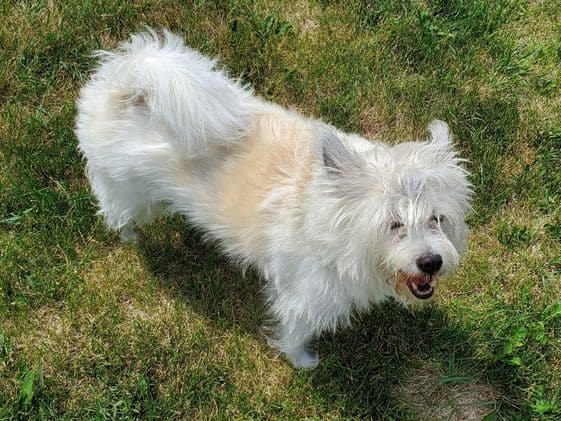
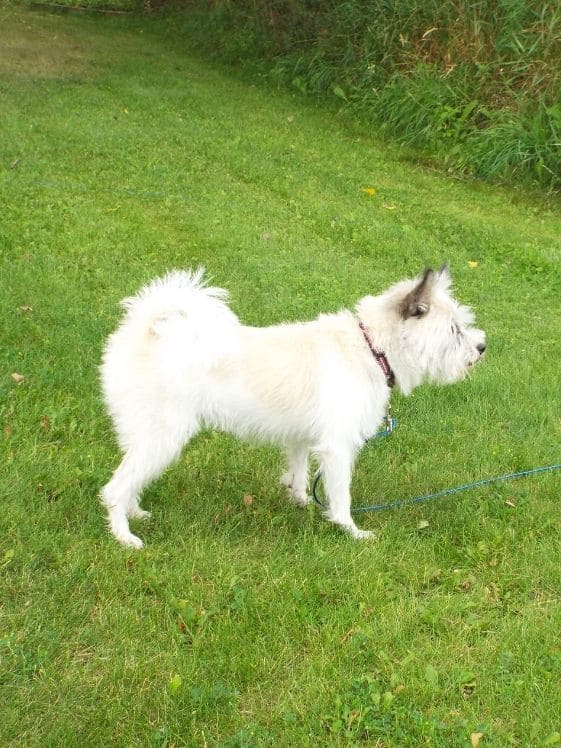
After a while, I looked at some pictures of American Eskimo Dogs, and yes, I can see the American Eskimo Dog in her, especially how her tail has always curled upwards (she’s the only one in the litter whose tail goes that way).
What I Did Next
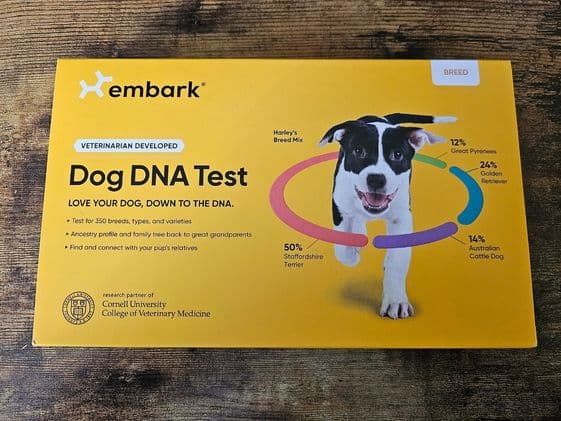
After the shock wore off, I was curious: would all the tests come back with the same results?
Only one way to find out. I ordered the Wisdom Panel and Embark DNA tests as well. I decided to stick with only doing the breed DNA and did not get the health history versions.

How The Test Process Compares
Testing-wise, all the tests were similar. Both the Ancestry and Embark tests required a 30-second swab; Wisdom Panel was only 15 seconds.
Ancestry requires food and water to be withheld for 30 minutes before testing; Embark just requires food to be withheld. Wisdom Panel required neither.
Both Ancestry and Embark require the swab to be inserted into a tube and shaken; Wisdom Panel requires it to sit and dry for 5 minutes.
All of them included a prepaid package to send it to the lab.
Ancestry took about 3 weeks to get back; Embark and Wisdom Panel were back in just under 3 weeks.
Overall, the process was similar and fairly simple to do.
How the Results Compare
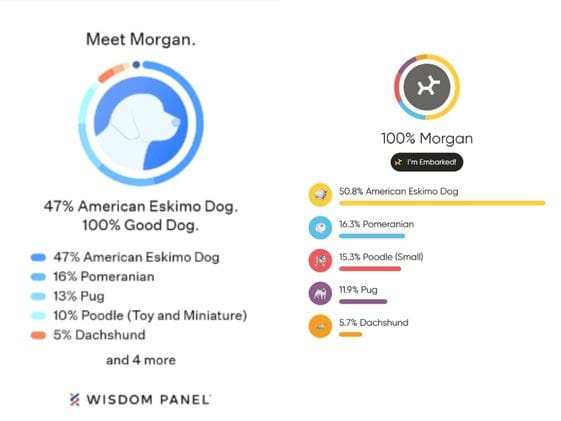
All 3 tests have Morgan as primarily an American Eskimo Dog. Embark has her as 50.8% American Eskimo, and Wisdom Panel has her at 47% compared to Ancestry’s 49%.
All 3 also have her as part Pomeranian, Poodle, and Pug, but with varying percentages.
Both Embark and Wisdom Panel also have a fifth breed of Dachshund, with Wisdom Panel at 5% and Embark at 5.7%.
As with Ancestry, neither test came back with any terrier. It’s been hard to accept that the breed we all thought she was the most of isn’t even in her list of breeds. For over 12 years, we believed she was a terrier, but no, she’s not.
Did The Test Change How We Care for Morgan
It’s been about a year since we did the tests, and I still struggle to think of her as not a terrier. It’s hard when you spend so much time believing she is one thing, to learn that she is, in fact, not that.
Her breed mix doesn’t change who she is, and doesn’t change the over 13 years we’ve now had her. But it can change her health risks.
Unfortunately, at her age, it’s hard to know how much longer we have with her. There isn’t much that knowing her breeds now will change how the vet is treating her.
She already has mitral valve disease and is on heart medication to slow its progression. She also has arthritis and is on meds for that.
Morgan has also already fought, and won, against immune-mediated thrombocytopenia, a disease (disorder?) that destroyed all her platelets. OMG, the bruising she had when they shaved her to do an ultrasound before they knew what was wrong was terrifying! Then, to find out she had almost no platelets (and this at the time of Covid, right before the lockdowns).
She’s had several health issues in the past (we jokingly said she liked to play “stump the vet” annually). Thankfully, the stump the vet times have stopped; it’s just her chronic, senior dog health issues that we have to handle now.
Even though getting Morgan’s DNA tested hasn’t changed much of how we treat or care for her, I’m glad we did it. Knowing that she is an American Eskimo Dog instead of a terrier hasn’t changed much, but it’s nice to know.
Final Thoughts
If you are interested in getting your dog’s DNA tested, look at all the tests carefully. Go to their websites and look at everything that is included for each test. They all offer more than one type of test.
Consider what you want to know, the age of your dog, and how readily you can make changes to your dog’s lifestyle based on what health conditions they are predisposed to. And decide if you want to know that.
There is no clear-cut; this test is better than that test. Choose based on what is right for you and your dog.
